
Optimizing Performance & Success for
Pro-Athletes & Growth-Minded Elites
When performance breaks under pressure,
it’s not a skill issue.
You’ve trained for this.
You know what to do.
But in competition — after injury, a mistake, or sustained pressure — execution changes.
Hesitation shows up.
Confidence drops.
What works in practice stops translating when it matters most.
And when it persists, careers stall, teams spiral, and seasons slip.
This is not mindset training, counseling or coaching. It’s a system-level reset — and the results are measurable.
15+ years specializing in subconscious performance
100% documented success rate with elite & professional athletes
Typical resolution: 1–2 sessions
Results tracked, repeatable, and confidential
Work conducted privately and non-disruptively
Why This Happens
Performance breaks when subconscious programming & associations override conscious intent under pressure.
The body reacts to perceived danger or consequence — not current capability.
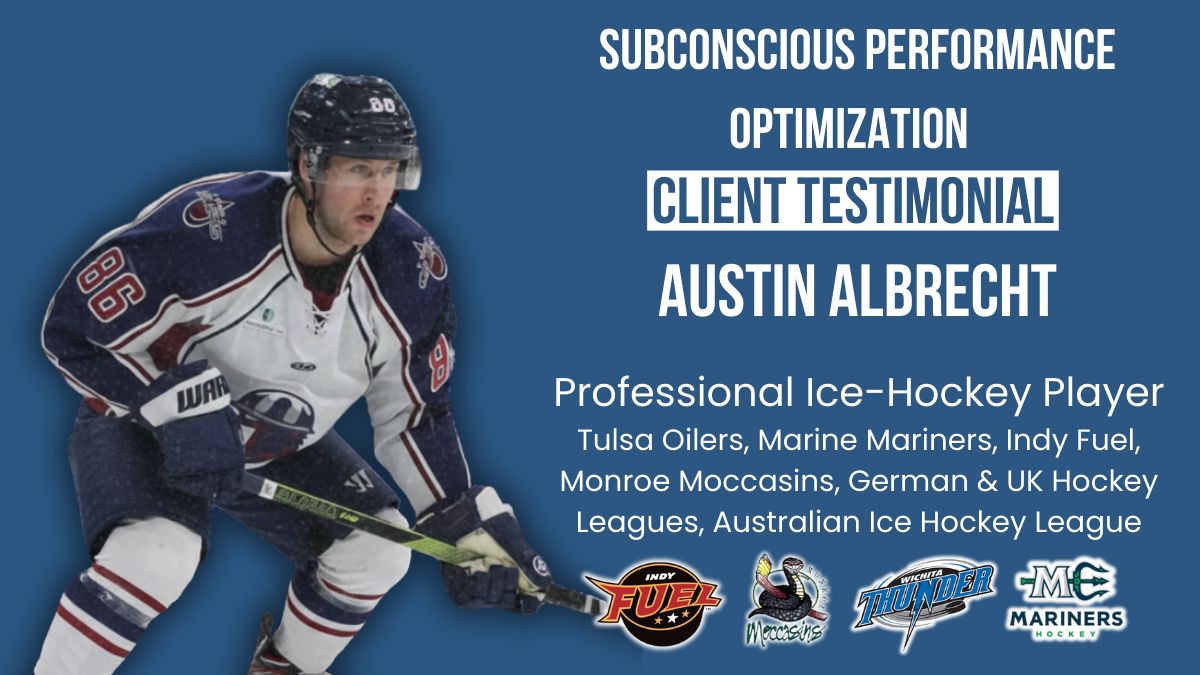
Austin Albrecht - Tulsa Oilers Pro-Hockey Player
“I went from freezing on the ice to playing calm, confident, and in flow again. After 2 sessions, I felt like I was back. One hundred percent.”
Context:
After seven years as a professional hockey player, Austin’s confidence had steadily eroded. Being traded multiple times during COVID disrupted his sense of stability, and two major injuries in a single year — including playing through a broken hand and taking a 100 mph puck to the face — compounded the issue.
Although physically cleared, his confidence continued to drop, especially in the months leading up to our work together.
What Was Breaking Performance
- Hesitation and “freezing” on the ice.
- Loss of flow and instinctive play.
- Progressive self-doubt & lack of confidence despite skill and experience.
- Strong awareness of the problem, but inability to understand why or shift it consciously.
- Austin’s coach referred him directly, recognizing that the issue was no longer physical or technical.
The Work
Subconscious reprogramming focused on clearing trauma-based fear responses, restoring trust in instinctive play, and removing the internal pressure that had been building over time.
Result
The shift was fast. Austin reported feeling calm, clear, and back to his old self.
In the next two games, he scored three goals, and the difference was immediately visible — even to his father watching from the stands.
He described returning to a flow state, playing with confidence and ease instead of forcing plays or overthinking. Fans and family noticed the change as much as he did.
Austin’s Perspective on the Work:
“Every sport is 90% mental. No matter where you're at in your sport, I highly recommend working with Tina-Nomad to help improve your abilities and unlock your full-potential.”
Why Performance Breaks at the Elite Level
Elite athletes do not struggle because of lack of discipline, motivation, or preparation.
Performance breaks when subconscious programming overrides conscious intent under pressure.
This is also why many athletes perform exceptionally well in practice, yet struggle to replicate that level in competition.
The skills are there. The difference is pressure — and how the subconscious responds to it.
This most often happens in two situations:
AFTER INJURY
When the subconscious associates a movement, position, or scenario with danger, hesitation appears — even when the body is medically cleared.
Athletes then try to force confidence consciously, which increases tension and degrades execution, often resulting in hesitation in key moments.
AFTER A MISTAKE
Especially when the mistake is public or high-stakes, the subconscious links future attempts to the emotional impact of that moment.
This is why athletes can execute flawlessly in practice, yet hesitate or over-control the same action in competition.
The subconscious is responding to perceived consequence, not capability.
That interference governs:
Confidence stability
Stress response
Hesitation versus instinct
Emotional carryover after mistakes
Training harder does not correct this.
Awareness does not correct this.
Subconscious reprogramming does.
How This Is Applied
My role is to remove the subconscious patterns and associations that interfere with execution under pressure — quickly and precisely — so athletes can perform from their actual ability again immediately.
This work does not require reliving experiences or managing emotions consciously. The change happens at the level that controls execution automatically.
Individual Performance Reprogramming (1:1)
Used when a single athlete experiences hesitation, confidence loss, or execution breakdown — most commonly after injury, a significant mistake, or under competitive pressure.
Typical scenarios include:
Playing tentatively after a serious injury despite full physical clearance
Performing at a higher level in practice than in competition despite equal preparation
Overthinking movements that were once automatic
Repeating the same error under pressure (e.g. missed putts, penalties, shots)
Forcing performance to override internal hesitation
Repeated negative emotions (e.g. angry outbursts or lack of desire to continue playing/performing)
The work removes subconscious danger and error associations so execution can return to being instinctive, clean, and reliable, allowing the athlete to perform in peak form and even improve upon their best results.
Team-Level Subconscious Reprogramming (Group Format)
Used when the same performance pattern is showing up across the team.
Common scenarios:
Losing streaks where the same mistakes repeat regardless of tactical changes
Teams collectively tightening up after losses or injuries
Long seasons (e.g. hockey) where energy, drive, and sharpness erode
Group-level error loops (e.g. repeated missed free kicks, penalties, or set plays)
Teams performing well in training but failing to translate that execution into competition
In these cases, the issue is not effort, motivation, or preparation.
It is a shared subconscious association — often formed around injury, failure, or pressure — that the team continues to reinforce unconsciously.
Group sessions are used to reprogram that shared pattern at the system level, allowing the team to respond to the present moment rather than past outcomes.
For Teams, Coaches & Performance Staff
I work directly with teams, coaching staff, and performance departments when collective performance no longer reflects capability — not just on the field, but across the system supporting it.
This often shows up when:
Injury clusters subtly change how athletes and staff approach risk and decision-making
Frustration, anger, or pressure begins to replace clarity in coaching or leadership
Drive and sharpness erode over long seasons, even in highly committed teams
Athletes and staff “know what to do,” yet execution breaks down under pressure
Teams perform strongly in practice but struggle to translate that level into competition
The same errors continue despite sound technical, tactical, and physical preparation
In these situations, the issue is rarely effort, discipline, or commitment.
It is a shared subconscious pattern affecting how the entire system responds to pressure — players, coaches, and staff included.
The work targets that system-level pattern, not individuals.
The objective is straightforward:
restore clear decision-making, stable drive, and reliable execution under pressure across the roster and leadership team.
⚠️ What This Is — and Is Not
This is subconscious performance reprogramming.
It works at the level of the internal “operating system” that controls 95% of thoughts, emotions, decisions, and reactions under pressure — and upgrades the programming that interferes with and controls execution.
This is not talk therapy.
There is no need to rehash or relive past experiences. The work happens quickly while the athlete is eyes-closed, relaxed, and regulated, making the process effortless for the person and immediate in its effects.
Athletes typically feel a shift right away and see it show up rapidly in confidence, stability, decision-making, and execution under real competitive pressure.
This work is:
This work is NOT:
Direct access to the subconscious “operating system” driving automatic performance responses.
Talk therapy or mental health treatment.
A rapid reprogramming process that removes danger, failure, and pressure associations and installs full access to all capabilities, confidence, and a winner mindset.
Motivational speaking, coaching, or hype-based sessions.
Designed for 1:1 athletes, coaches/staff, or teams without disrupting existing training systems.
Emotional analysis or reliving past experiences.
Focused on immediate, observable shifts rather than long-term processing.
Long-term mindset programs that require ongoing maintenance.
The goal is not to “push through” or force confidence.
The goal is to upgrade the subconscious programming that’s creating the interference, so execution returns to what the athlete, coach, or team is already capable of, and improve upon that — easily, consistently, and reliably.
Documented Performance Outcomes
Selected outcomes from elite and professional athletes.
All work conducted privately and confidentially.
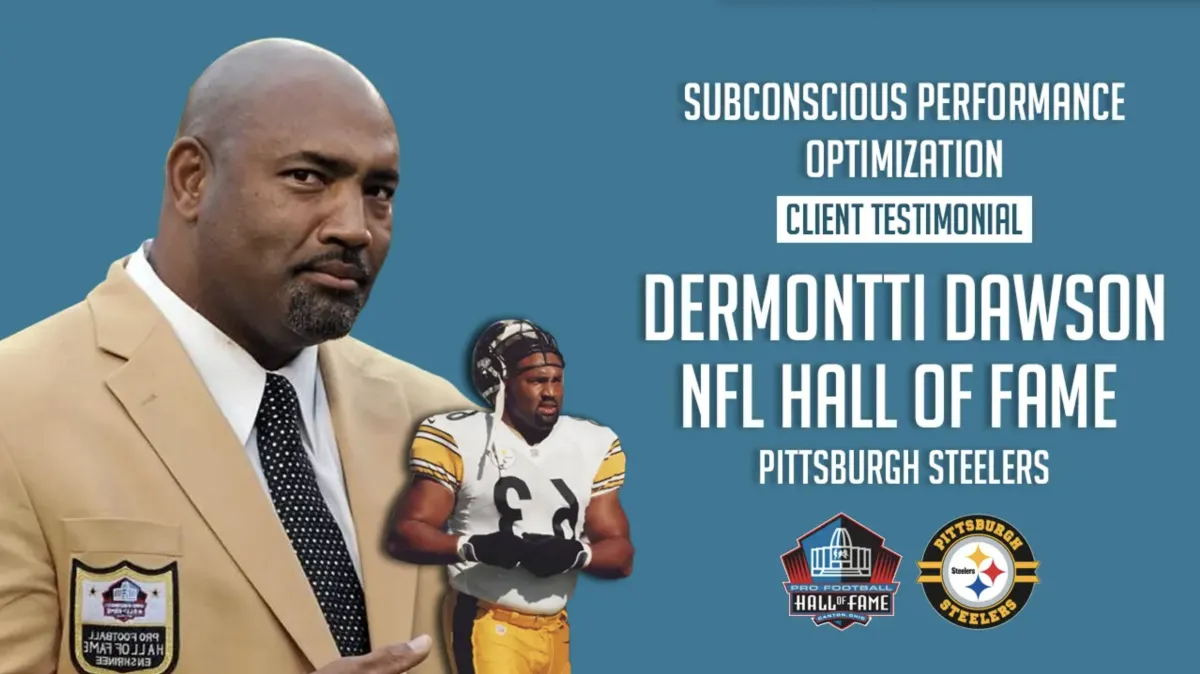
Dermontti Dawson - NFL Hall of Fame Pittsburgh Steelers
“I wish I had worked with Tina-Nomad during my NFL career — it would have given me a real competitive edge on the field.”
Issue:
Emotional reactivity and internal pressure under public scrutiny.
Resolution:
Subconscious reprogramming sessions.
Outcome:
Emotional responses stabilized; maintained clarity and composure consistently.
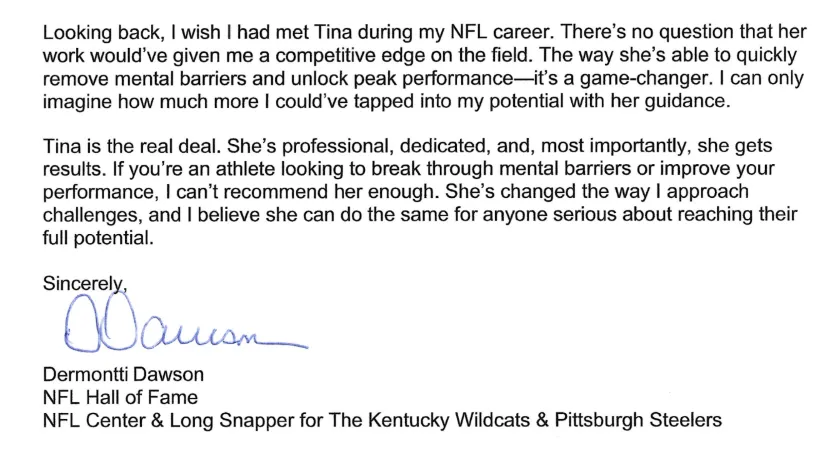
Letter of Recommendation from Dermontti Dawson
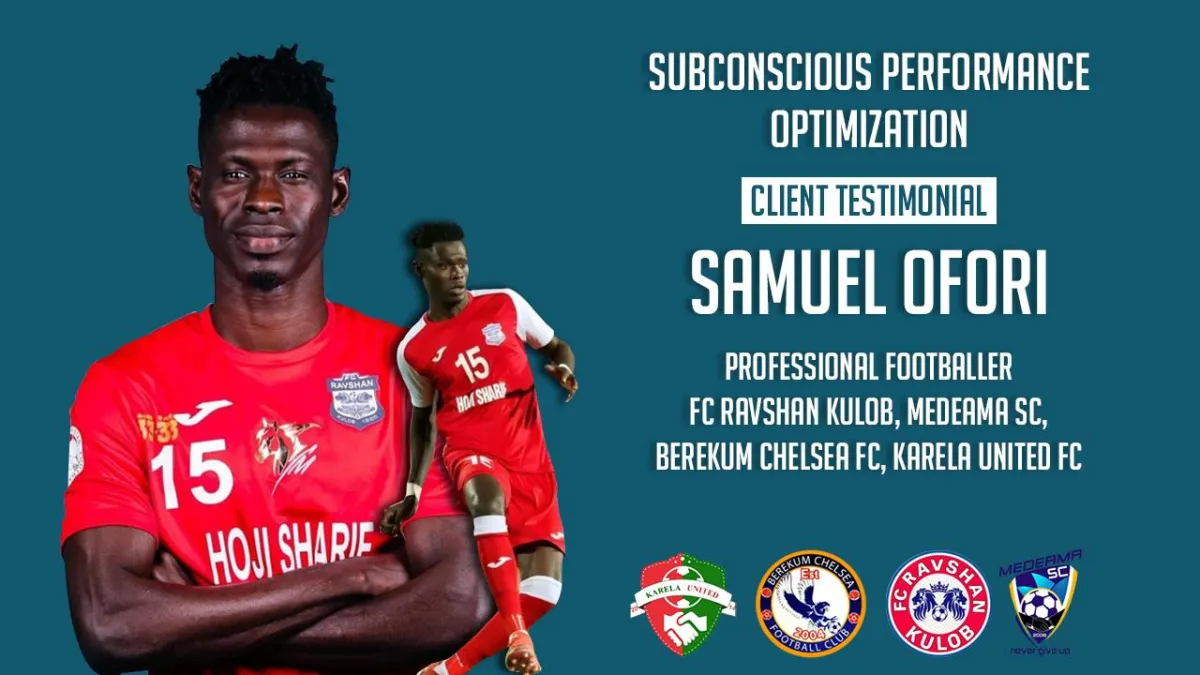
Samuel Ofori - AFC Champions League
Pro-Footballer/Soccer Player
“I used to lose control when I was provoked, which was costing me yellow cards. Now nothing phases me on the pitch.”
Issue:
Anger outbursts when provoked during matches, leading to yellow cards, dismissals, and unnecessary time off the pitch.
Resolution:
Subconscious anger response resolved in the first session.
Outcome:
Provocation no longer triggers emotional reactions. No longer phased in-game. Yellow cards and dismissals dropped off, resulting in greater availability, improved consistency, and stronger overall match performance and statistics.
(A second session was completed, but the core issue resolved in session one.)
Quintus McDonald - Penn State National Champion,
Indiana Colts Ed Block Courage Award Winner,
San Francisco 49ers NFL Football Player
“We worked on two different issues, and both were cleared in just one session each — some very deep-rooted stuff.”

Jake Jervis - PFA Northern League Premier Division
Pro-Footballer/Soccer Player
“I knew I was capable of more. After 2 sessions, my confidence improved, and my performances followed.”
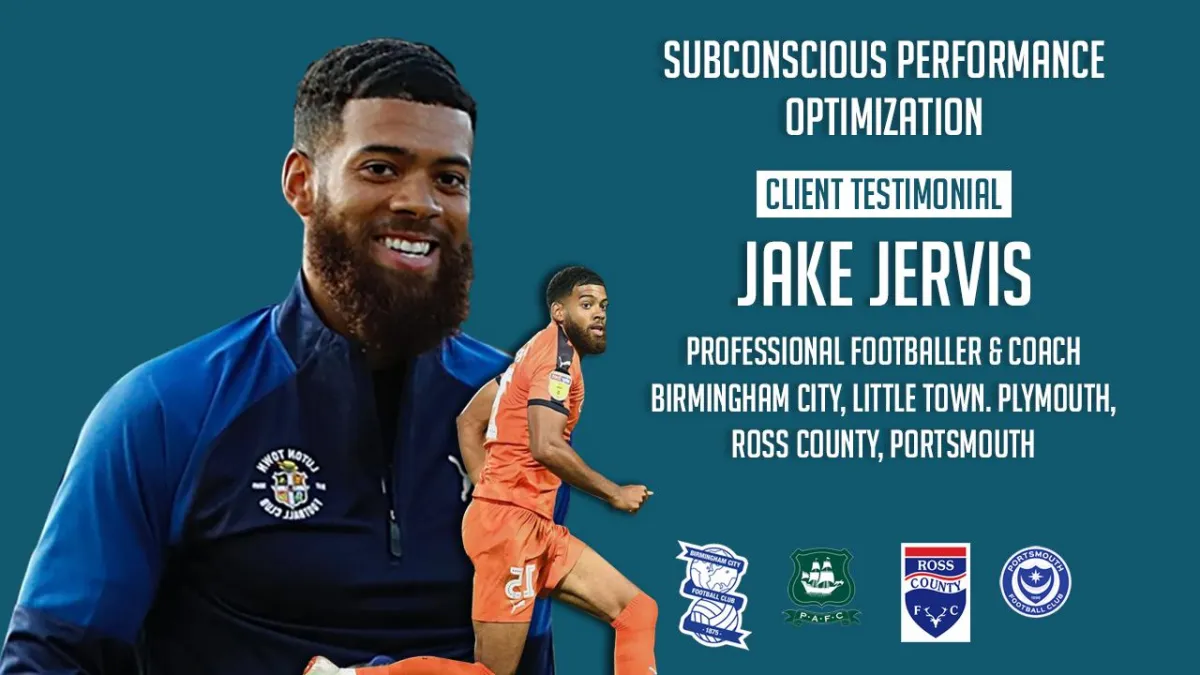
Issue:
Loss of confidence and overthinking during matches despite strong training form, leading to hesitation and inconsistent execution in competition.
Resolution:
Two targeted sessions addressing subconscious pressure and self-doubt patterns.
Outcome:
Confidence stabilized quickly. Decision-making simplified. Immediate improvement in match execution, reflected in scoring outcomes shortly after sessions.
Testimonials
“Once the fear response was cleared, I could stay present and execute instead of reacting.” ISSUE: Emotional reactivity and hesitation during fights following earlier losses. Despite strong conditioning and preparation, hesitation appeared in key moments, disrupting timing and aggression. RESOLUTION: Targeted subconscious reprogramming addressing fear, pressure, and fight-specific associations. OUTCOME: Emotional reactivity resolved. Fighter reported clearer presence in the cage, improved composure under pressure, and the ability to execute game plan without hesitation.

“After one miss, I started missing short putts I never miss in practice. Now they’re automatic again in competition.” ISSUE: After a highly visible miss during competition, the golfer began repeatedly missing short putts (tap-in range). Despite flawless putting in practice, competition triggered tightening, over-control, and second-guessing on shots that should have been simple and automatic. RESOLUTION: Subconscious reprogramming focused on clearing the error association tied specifically to short putts and competitive pressure. OUTCOME: The missed-putt association no longer carried forward. Short putts returned to being automatic and instinctive in competition. Putting performance under pressure aligned with practice ability, true capability, and clean precision.

“Clearing the shared pressure association on penalty shots broke the team-wide penalty pattern, allowing each player to execute without hesitation.” ISSUE: Repeated missed penalty shots across multiple matches. Despite technical ability and focused training, the same outcome continued game after game, creating mounting pressure and hesitation around penalties. RESOLUTION: Team-level subconscious reprogramming focused on clearing the shared pressure and failure association that had formed around penalty situations. OUTCOME: The collective penalty-related pressure dissolved. Players returned to executing penalties from their individual skill and instinct rather than a team-wide fear response. Confidence and composure in penalty situations stabilized, and execution normalized from that point forward.

“I stopped trying to force performance in games, and it started showing up naturally.” ISSUE: Consistently strong performance during practice and training, but noticeable drop-off during games. Tightening, hesitation, and overthinking appeared under competitive pressure, leading to under-performance when it mattered most. RESOLUTION: 2 sessions addressing subconscious pressure and evaluation-based interference. OUTCOME: Game performance aligned with practice ability. Execution felt automatic rather than forced. Confidence and focus during games stabilized, allowing the athlete to play freely instead of trying to “make it happen.”

“The anxiety that used to take over on race day was gone — I could finally run the way I trained.” ISSUE: Persistent anxiety around competition. Despite being physically prepared, Gary experienced tightness, overthinking, and nervous anticipation before races, which interfered with rhythm, timing, and execution on race day. RESOLUTION: Subconscious reprogramming focused on the anxiety response and competition-specific pressure associations. OUTCOME: Anxiety dropped off completely. Pre-race nerves no longer hijacked focus or body awareness. Races felt calmer and more controlled, allowing Gary to compete with the same freedom and confidence he experienced in training.

“I sent Tina-Nomad athletes struggling with everything from anger on court to underperformance. Every one of them got the results they wanted — quickly.” ROLE: Professional Tennis Coach (Competitive Youth, Tournament Players & College Players) ISSUE: Athletes struggling with a range of issues, including anger outbursts on court, emotional reactions to and repeated mistakes, distraction, loss of focus, and under-performance in matches despite strong training results. RESOLUTION: Each athlete received targeted subconscious reprogramming, with the presenting issue typically resolved within 1–2 sessions. OUTCOME: Every athlete achieved the specific result they came in for within the first two sessions. Emotional outbursts stopped, focus stabilized, and match performance aligned with training ability, resulting in being placed on higher-level, more elite teams. Based on consistent outcomes, the coach continued referring athletes over the past 13 years.
